
Why AI Readiness Comes Down to People, Process, and Confidence
By Jennifer McMullen, Chief Strategy Officer, Annuity Health
Everyone is talking about AI in revenue cycle right now. Boards want updates, vendors are pitching solutions, and leaders are being asked some version of, “So, what’s our AI strategy?” At the same time, a lot of organizations are quietly running into the same wall.
It’s not that the technology isn’t impressive. It’s that the foundation underneath it isn’t ready.
What’s missing, more often than not, is confidence. Confidence in the data feeding the system, in the workflows shaping that data, and in what teams are expected to do with AI-generated outputs once they receive them. When that confidence isn’t there, even very capable AI tools tend to stall.
Industry research is starting to confirm what many operators already feel day to day. Nearly three-quarters of revenue cycle leaders report that poor data quality, including inconsistent codes, missing fields, and incomplete encounters, significantly undermines their ability to use AI and analytics effectively¹. These aren’t edge cases. They’re common realities.
The issue isn’t lack of ambition, effort, or interest. It’s that AI often gets treated like a shortcut, when it’s really an amplifier. It accelerates whatever systems, habits, and decisions already exist. When the foundation is clear and consistent, that acceleration builds confidence. When it’s not, it creates hesitation.
So AI readiness isn’t really a technology problem. It’s a people problem. A process problem. And ultimately, a confidence problem.
The good news is that confidence is built, not assumed. And leaders have far more influence over it than they often realize.
What the Industry Is Actually Running Into
Adoption of AI in revenue cycle is clearly underway. Nearly half of U.S. hospitals and health systems now report using AI in some part of their revenue cycle operations². The intent is clear. Leaders are looking for ways to improve efficiency, accuracy, and staff productivity.
But adoption alone doesn’t equal readiness.
Seventy-four percent of revenue cycle leaders cite data quality as a major barrier to AI success¹. About two-thirds say data governance is underfunded compared to investments in tools and models¹. Integration remains another major friction point, with 76 percent describing EHR and practice management integration as a severe or significant challenge³.
The most telling signal may be this: nearly 80 percent of organizations have delayed or paused at least one AI or analytics use case because they didn’t feel confident in the data behind it¹.
Those decisions aren’t failures of innovation, they’re operational reality checks made by teams who don’t yet feel confident acting on the data.
AI Reveals the Foundation You Have
AI doesn’t create clarity. It exposes whether it already exists. It surfaces weak data definitions. It highlights workflows that look clean on paper but fall apart in practice. It reveals gaps between who owns decisions and who is accountable for outcomes.
Technology doesn’t fix those issues. It reflects them. That’s why AI readiness has less to do with sophistication and more to do with alignment, alignment across data, workflows, roles, and expectations. When those pieces line up, confidence follows. And when teams are confident in what they’re seeing, they’re far more likely to act on it.
The AI Readiness Field Guide
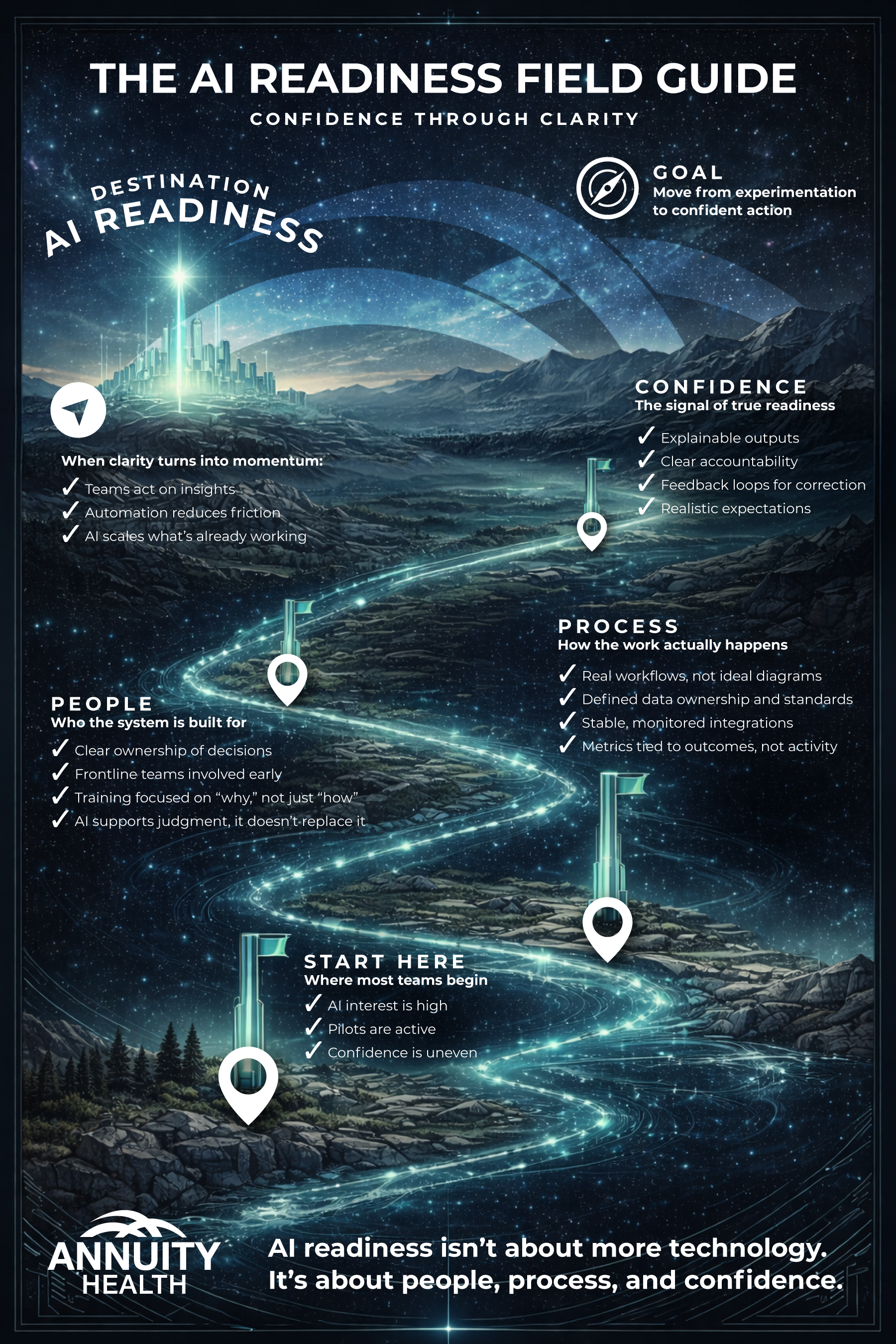
Rather than talking about AI in the abstract, it helps to get practical. Think of AI readiness as a field guide focused on what actually has to be working day to day before AI can realistically deliver value.
People
AI works best when the people closest to the work are involved early. That means clear roles, training, and transparency around how recommendations are generated. The American Hospital Association notes that AI can improve staff efficiency and accuracy, but only when outputs are understood and validated by people who know the work².
Process
Strong foundations start with honest workflow mapping, not idealized diagrams. Data governance, stable integrations, and meaningful measurement matter far more than advanced features. If a process isn’t clear without AI, automation will only amplify confusion.
Confidence
Confidence grows when outputs are explainable, feedback loops exist, accountability is clear, and expectations are realistic. Teams need to know not just what the system is recommending, but why, and what happens when it’s wrong.
Each of these elements builds confidence in a different way, in the data, in the process, and in the decisions teams are asked to make. This is where readiness either holds or collapses.
Responsible AI Adoption
Responsible AI adoption isn’t about slowing innovation. It’s about making it sustainable.
That means no hype. No blame. No shortcuts.
It means shared ownership between leadership, frontline teams, and partners. It means protecting staff from being held accountable for tools they don’t yet have confidence in. And it means being honest about where AI can help today and where foundational work still needs attention.
When AI is positioned as a support system rather than a silver bullet, it creates space for learning, adjustment, and real progress.
Confidence Is the Real Readiness Metric
AI success doesn’t start with the algorithm. It starts with confidence.
Confidence that the data is accurate and consistent. Confidence that workflows are understood and stable. Confidence that when AI surfaces a recommendation, teams know what to do next and who owns the outcome.
That confidence doesn’t come from buying better tools. It comes from clarity, clarity in data definitions, clarity in process design, and clarity in roles and expectations.
When leaders invest there, AI stops being a risky bet and starts becoming a practical accelerator. Teams hesitate less. Decisions move faster. Automation supports people instead of surprising them.
That’s what real AI readiness looks like. And that’s when AI finally has the chance to deliver on its promise.
References
- Black Book Research. Healthcare RCM Leaders Say AI Ambitions Are Running Ahead of Data Reality. (accessed via press release / industry coverage. Also summarized and cited by Becker’s Hospital Review.)
- American Hospital Association. 3 Ways AI Can Improve Revenue-Cycle Management.
- Becker’s Hospital Review. The Top Barriers to AI in Revenue Cycle Management.